

First home buyers vs returning investors: who’s driving property prices?
Australia’s housing market is heating up again, with both first home buyers and returning investors competing for limited stock.
The Reserve Bank of Australia (RBA) has warned that a surge in investor activity could amplify price swings, even as government incentives help more first home buyers enter the market with smaller deposits.
Investor activity gaining pace
As the graph below shows, investor borrowing is now increasing more rapidly than lending to owner-occupiers, based on recent data.
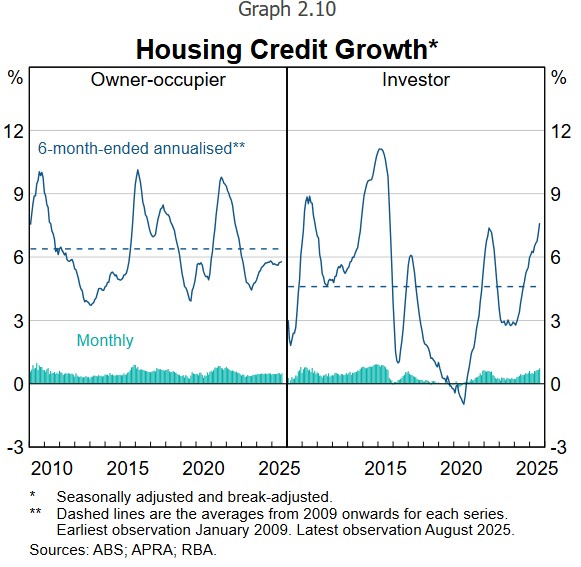
After several years on the sidelines, many investors are re-entering the market to capitalise on rising prices. This renewed activity tends to magnify price cycles, particularly in major cities where competition for established homes remains fierce.
“A high concentration of investors could contribute to a housing price upswing that raises the risk of, or exacerbates, a subsequent market correction down the track,” the RBA said in its October financial stability review.
First home buyers competing for entry-level homes
At the same time, more first home buyers are taking advantage of federal and state government schemes that allow deposits as low as 5%. Lower interest rates have also helped open the door to buyers who were previously priced out.
That’s created intense competition at the affordable end of the market, particularly for smaller homes and townhouses in well-located suburbs.
Prices climbing again
With both groups zeroing in on similar properties, pressure is building. National home prices rose 0.8% between August and September, the strongest monthly gain since October 2023, according to Cotality. The lift has been driven by combined demand from both first home buyers and investors. As long as both cohorts remain active, competition is likely to stay tight through the rest of the year.
What this means for investors
For those looking to grow their portfolio or re-enter the market, timing and strategy are critical. The RBA’s comments highlight how increased investor activity can accelerate both the upswing and downswing of price cycles. This means that while short-term capital gains may be possible, investor-heavy markets can become more volatile if sentiment shifts.
The key is to focus on fundamentals – assets that can deliver a solid performance throughout housing market cycles.
Look for properties in areas with strong long-term demand drivers such as population growth, employment hubs and infrastructure investment. A solid rental yield is just as important as capital growth, helping to manage holding costs and weather market corrections.
Sound risk management is also essential. Factoring in serviceability buffers, potential rate changes and vacancy periods can help ensure your investment portfolio remains sustainable in softer conditions. Diversifying across property types and locations can further reduce exposure to market-specific shocks.
Ultimately, successful investors think beyond the next price movement. By understanding broader market dynamics – including the balance between first home buyer and investor demand – you can build a resilient portfolio that performs across the full property cycle.